

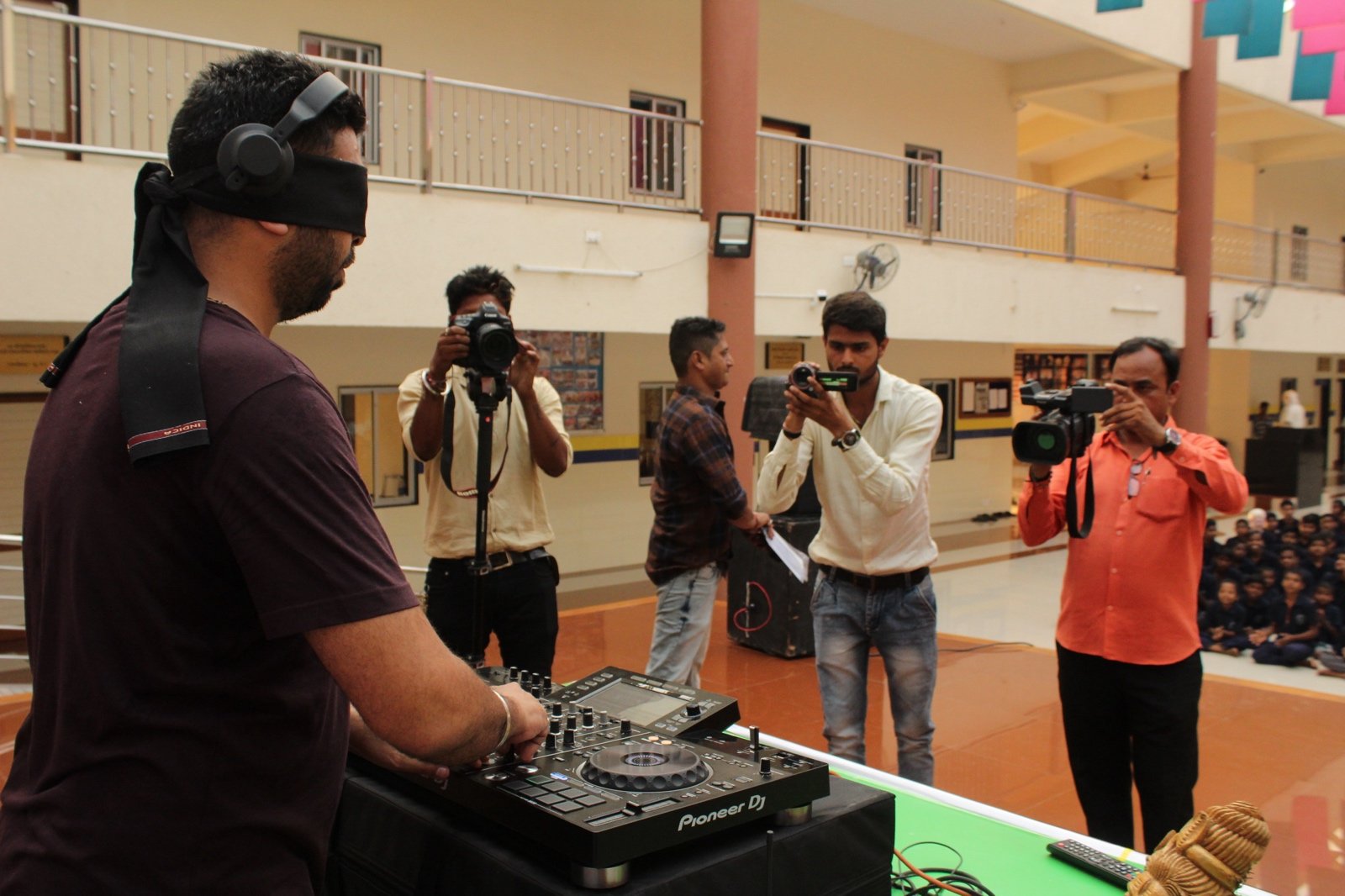
DJing gets talked about as an audio art, but anyone who’s actually watched a set from the booth knows better. The modern setup is a wall of visual information, waveforms, cue points, track data, screens everywhere. Performers navigate as much by sight as by sound, whether they’d admit it or not. In October 2018, DJ Toons decided to find out what was left once that visual layer disappeared entirely.
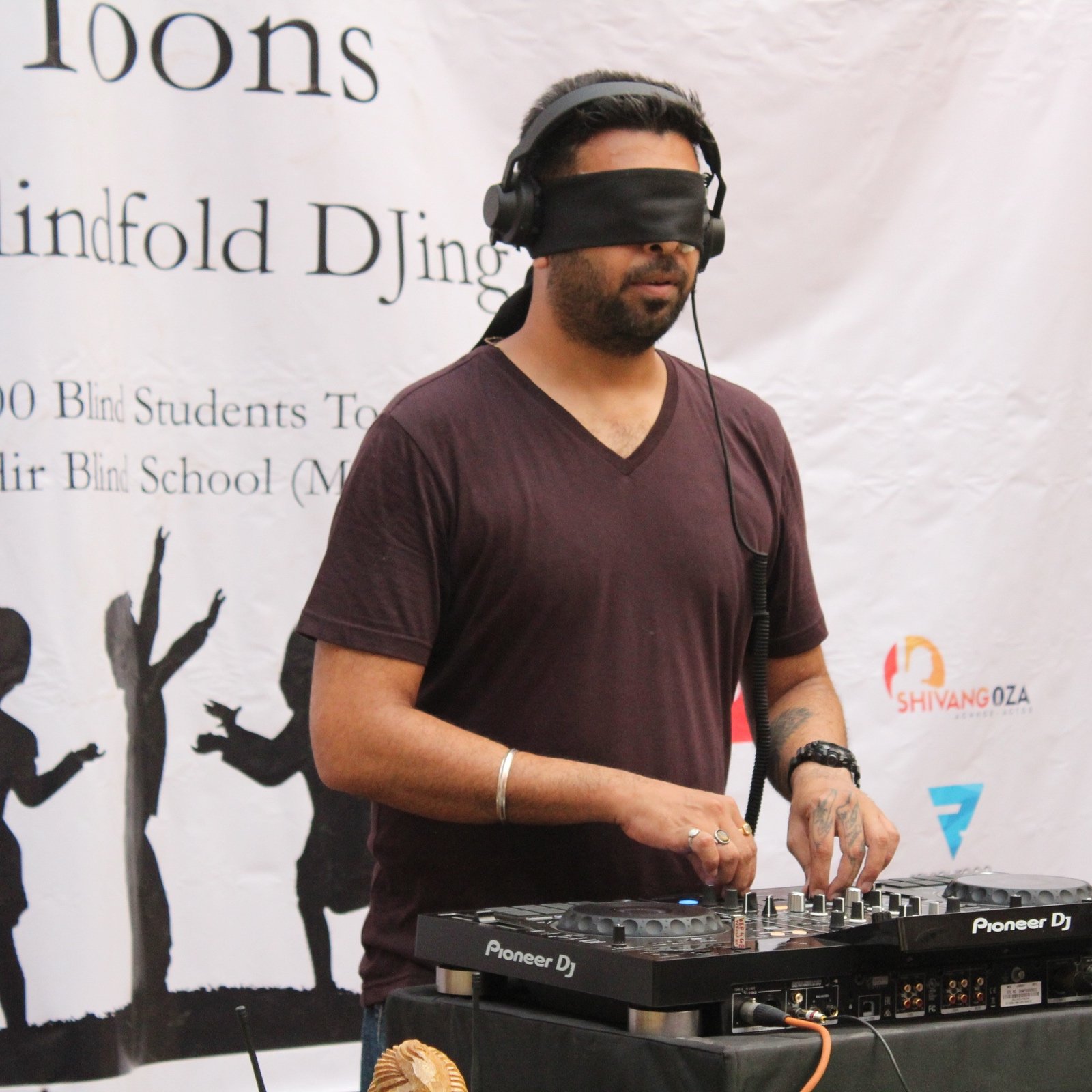
At Pragna Mandir School in Dang, Gujarat, a school for visually impaired students tucked into one of Gujarat’s most densely forested districts, he played a blindfolded set, 1 hour, 16 minutes and 57 seconds, for an audience of more than 100 students. The World Book of Records (UK) and the Incredible Book of Records (India) both logged it. The certificates are the least interesting part of this story. The real question is simpler and harder: how much of DJing actually depends on being able to see?
Ears Doing the Job Screens Usually Do
Strip away the visual interface and a DJ loses every shortcut, no glancing at a waveform to confirm a track’s position, no reading a transition coming before it’s audible. What’s left is listening, memory, timing and muscle memory doing all the work a screen normally handles. “I’d played thousands of sets by then, but I’d never actually had to trust my hands the way I did that day,” Toons says of the performance. “You realise very quickly that your fingers already know the controller better than your eyes ever did. It’s just that you never had to prove it before.”
For Toons, that meant the ears became the primary instrument and physical familiarity with the gear became non-negotiable. This wasn’t a stunt about surviving an hour blindfolded. It was a genuine test of what actually remains of the craft once you remove the tool most contemporary DJs have quietly become dependent on.
Technology Didn’t Vanish, the Dependence Did
There’s a sharper point in here about the relationship between DJs and their equipment. Modern gear can display an enormous amount of information, but information isn’t judgement. A waveform tells you where a track sits; it doesn’t tell you whether the track belongs in this moment. Software can smooth a transition; it can’t read a room’s emotional temperature.
“The screen tells you what’s happening. It doesn’t tell you what should happen next,” Toons has said of the experience. “That part’s always been on you, blindfold or not. The blindfold just made it obvious.”
Toons’ set made that gap impossible to miss. Tech works best as support for listening, not a substitute for it. The gear supplies data, but interpretation still has to happen in the performer’s head.
A School Built Around Sound: Pragna Mandir
Music has a particular pull in schools for visually impaired students, and by most accounts of how these institutions run, that’s by necessity as much as tradition. Where a mainstream classroom leans on the whiteboard and the printed page, music teaching in this setting tends to happen by ear, by touch, by repetition, students learning a rhythm pattern the same way they learn a room’s layout: through the body, over time, until it becomes instinct rather than instruction.
That’s the environment Toons walked into in 2018, and it’s worth sitting with, because it reframes what the blindfolded set actually was. He wasn’t the only person in the room without visual access to the equipment. He was, for one afternoon, working inside the same sensory logic his audience lived in every day. Teachers in these schools often talk about music and movement as core to the curriculum, not an extracurricular add-on, precisely because sound carries so much of what sight would otherwise do: orientation, feedback, a sense of where you are in space and time. Students who grow up learning that way tend to develop an unusually precise ear, the kind of listening that notices a shift in tempo or texture long before a sighted audience would consciously register it.
An Audience on Equal Footing
The setting did as much work as the blindfold itself. The students at Pragna Mandir were already navigating the world through sound rather than sight, so for once, performer and crowd were operating on identical terms. Toons lost his visual reference for an hour; his audience had never had one in the room to begin with. “That crowd could hear things in the set I couldn’t,” Toons says. “They’d clock a filter sweep or a tiny change in the low end before I’d even finished it. I was the one wearing the blindfold, but they were the ones who really understood what I was doing without sight.” That’s what elevated the blindfold past gimmick territory. It wasn’t a trick performed at an audience. It was common ground, briefly shared, with an audience whose ears were, if anything, sharper than his own.
The Real Story Came Eight Years Later
Here’s the part that actually matters. In March 2026, Toons went back to Pragna Mandir School, not to repeat the stunt, but to teach. He worked with more than 100 visually impaired students, introducing them to DJing directly. “In 2018 I was proving something to myself,” Toons reflects. “In 2026 I wanted to hand that over. It’s one thing to show a room you can DJ without sight. It’s a completely different thing to give a hundred kids the tools to do it themselves.”
That’s a fundamentally different question from the one he answered in 2018. Back then it was: can a DJ perform without sight? In 2026 it became: can people who’ve never had access to a visual interface learn to DJ from scratch? The second question is the bigger one, and it’s the one with actual staying power.
Rebuilding DJ Education From the Ground Up
The 2026 workshop ran on sound, touch, rhythm and tactile mapping of the equipment, with the students learning from each other as much as from him. Tactile mapping in particular changes the entire learning process, instead of memorising a controller by sight, a student builds a physical, felt map of where every control lives and what it does. “Some of them picked up beatmatching faster than students I’ve taught who could see the waveform right in front of them,” Toons says. “Once you stop relying on your eyes to confirm what your ears already know, you actually get faster, not slower.”
That has implications well past accessibility. DJ education right now is built almost entirely around screens. An audio-first, touch-first method might sharpen listening instincts in sighted beginners too, instead of letting them lean on visual shortcuts from day one. What started as an accessibility experiment ends up quietly questioning how DJing gets taught, period.
A Record Isn’t a Verdict on the Music
Worth being clear-eyed here: a blindfolded world record doesn’t automatically make someone a great DJ. It demonstrates preparation, technical confidence and a deep physical relationship with the equipment, not necessarily taste, selection or artistic instinct. Those still get judged on the music itself, full stop.
What makes this worth writing about isn’t the record. It’s that the record didn’t stay a closed chapter, it turned into an educational approach aimed at getting more people behind the decks who’d never had a way in.
Part of a Longer Arc
This sits inside a much bigger career: Bollywood, Psy-Trance, production, performance, and now education. Read against that backdrop, the 2018 set looks less like a headline-chasing stunt and more like one expression of a producer’s ongoing curiosity about how the craft actually works. “I don’t think about it as two separate things, the record and the workshop,” Toons says. “The record just happened to be the moment that showed me where the real work was.”
The interesting part was never whether he could get through an hour without seeing the decks. It’s what that hour taught him, and what he did with it years later.
From “Can I?” to “Who Can?”
A record answers a narrow question: can this be done. The 2026 workshop asked a much wider one: who else could do this, if it were taught differently. That’s the shift that turns a technical feat into something with real weight behind it. DJ Toons’ blindfolded set started as an experiment in removing sight from DJing. Its more lasting impact might be helping remove the barriers to who gets to stand behind the decks in the first place.
Follow DJ Toons on Instagram: @djtoonsofficial @bspdjs
Website: www.djtoons.com
